Family Mediation Tips: Navigating High Emotions


When relationships break down, family mediation, also known as Family Dispute Resolution (FDR), is a constructive way to resolve conflicts without going to court.
You need to come to mediation with an open mind and a willingness to cooperate as this will increase the chances of a settlement.
At Perth Divorce Lawyers we understand what you’re going through and are here to guide you through this process with expertise and empathy. This guide will walk you through the basics of family mediation, providing valuable tips to help you achieve the best possible outcome for your unique journey to resolution.
What is Family Dispute Resolution (FDR)
Family Dispute Resolution is a structured process designed to help separating couples resolve disputes related to property division and children’s matters. In Western Australia, FDR with respect to children’s matters is governed by the Family Court Act 1997 (WA), section 66H as well as the Family Law Act 1975 (Cth.), section 60I.
Under Australian family law, with some exceptions, Family Dispute Resolution is a mandatory step for separated parents before applying to a Family Law Court for parenting orders. The process is to facilitate open communication and negotiation between the parties to reach mutually acceptable agreements.
Who attends FDR?
- Separating or divorcing couples
- Parents with disputes over property and child-related issues
- In some cases, other family members or support persons (with agreement from all parties)
The mediator, a neutral third party, helps facilitate the conversation but doesn’t make decisions for the participants. Their role is to guide the conversation, make sure both parties are heard and help identify solutions.
How much does Mediation and FDR cost?
The cost of mediation varies depending on the service provider and the complexity of your case. Some community-based services offer reduced fees based on income, while private mediators charge hourly rates. At Perth Divorce Lawyers we have transparent fee structures and can discuss costs at your initial consultation.
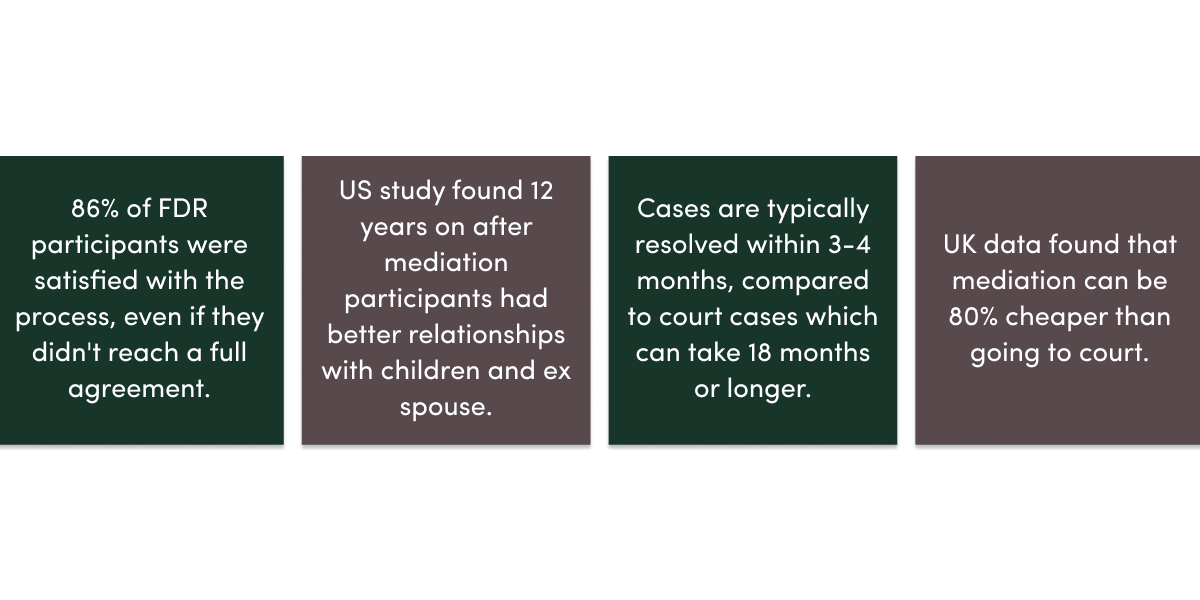
While there is a cost to mediation, it’s generally much cheaper than going to court. And the potential for a quicker resolution can save you more in the long run.
Common Key Issues in Family Mediation
Property Division
One of the biggest parts of family mediation is property matters.
- Division of assets and liabilities
- Superannuation splitting
- Dealing with the family home
- Valuation of businesses or other complex assets
- Considering future financial needs of both parties
Property division can be particularly complex in cases involving high-net-worth individuals or when there are business assets to consider. Our team at Perth Divorce Lawyers is well experienced in property settlements and can provide guidance throughout the mediation process.
Children’s Matters
When children are involved, mediation focuses on:
- Parenting arrangements (including living arrangements and visitation schedules)
- Child support
- Education decisions
- Health and welfare considerations
- Communication between parents
- Holiday and special occasion arrangements
Effective communication with your ex-partner is key to developing a cooperative co-parenting relationship which benefits the children’s long-term well-being and their relationship with each parent. The focus in these discussions is always the best interests of the children. Mediation can help parents develop a cooperative co-parenting relationship, which is good for the children’s long term welfare.
Top Tips to Get the Most from the Mediation Process
Start by preparing thoroughly and familiarise yourself with the process ahead, preparation is key to a successful mediation. Thorough preparation is key to resolving family law disputes during mediation.
- Determining your priorities: What are your non-negotiables and where are you willing to compromise?
- Understanding your legal rights: Familiarise yourself with relevant family law in Western Australia by taking independent legal advice.
- Collating relevant documents (financial statements, property valuations, etc.)
- Making an honest attempt to resolve issues before mediation: Try to identify areas of agreement and disagreement beforehand.
Our experienced family lawyers can help you prepare for your mediation session so you have all the necessary information and documents.
Manage Your Emotions
Emotional management is crucial to a balanced and constructive mediation process.
- Stay calm and focused: Practise deep breathing or other relaxation techniques if needed
- Practice self-care and seek support if needed: Consider counselling or therapy to help process your emotions
- Remember that mediation is about finding solutions, not rehashing past conflicts
- Take breaks during the mediation session if you feel overwhelmed
Be Aware of Your Communication
Good communication can steer mediation to a fair and amicable outcome.
- Using “I” statements to express your needs and concerns: For example, “I feel concerned about…” rather than “You always…”
- Listening actively to understand the other party’s perspective: Try to paraphrase what you’ve heard to ensure understanding
- Choosing your words carefully to avoid escalating tensions: Focus on the issue at hand rather than personal attacks
- Being open to feedback and willing to clarify your points if misunderstood
Prepare for Roadblocks
Anticipate potential hurdles and be ready to address them constructively.
- Identifying key issues in advance: What are the likely sticking points?
- Considering alternative solutions to common sticking points: Come prepared with several options
- Being open to compromise while maintaining your core priorities
- Being open to compromise and negotiation with the other party can help overcome potential roadblocks
- Seeking advice from your lawyer on how to navigate difficult topics
Ensure Your Safety
If there are any safety concerns inform your mediator or lawyer immediately. In cases involving family violence, inform your mediator or lawyer to ensure appropriate safety measures are in place. Mediation should always take place in a safe and secure environment.
Options such as separate waiting areas or even shuttle mediation (where parties are in separate rooms) can be arranged if necessary.
Be Willing to Compromise
Successful mediation often requires flexibility from both parties.
- An open mind: Be willing to consider perspectives and solutions you hadn’t thought of before
- Willingness to consider alternative solutions: Sometimes, creative problem-solving can lead to win-win outcomes
- A focus on the big picture and long-term outcomes: Consider how decisions will impact your life in the years to come
- Realistic expectations: Perfect solutions are rare, but good compromises are achievable
Know the Costs
Be clear about the financial aspects of mediation.
- Know the mediator’s fees and any additional costs: Ask for a clear breakdown of expenses
- Consider how mediation costs will be shared between parties: This can often be a point of negotiation
- Weigh the cost of mediation against potential legal fees for court proceedings: Mediation is typically much less expensive than litigation
- Budget for potential outcomes: Consider the financial implications of various settlement scenarios
Get Legal Advice
While mediators can provide information they cannot give legal advice. A Family Dispute Resolution Practitioner can facilitate mediation sessions and issue Section 60I certificates if necessary. It’s important to:
- Consult with a family lawyer before and during the mediation process
- Understand your rights and obligations under Western Australian law
- Have any agreements reviewed by your lawyer before finalising
- Consider having your lawyer present during mediation sessions if complex legal issues are involved
Confidentiality
Mediation discussions are generally confidential; this allows for open and honest communication. However, there are some exceptions, such as when there’s a risk of harm to a child. Your mediator will explain the confidentiality rules at the beginning of the process. Respecting this confidentiality can help build trust and facilitate more productive negotiations.
Benefits of Family Mediation
Family mediation offers numerous advantages over traditional court proceedings. Not only is it typically more cost-effective and faster, often resolving disputes in weeks or months rather than years, with almost two thirds (65%) of participants reaching partial or full agreements.
Instead of a judge making decisions for you, mediation allows you to create solutions that are tailored to your family’s needs. This collaborative approach often leads to better communication between parties and less stress for all involved, including children.
Moreover, mediation allows for creative problem solving that may not be possible in a courtroom. This combined with both parties being actively involved in creating the solution often leads to higher compliance with agreements. Successful family law mediation can lead to better communication, less stress and higher compliance with agreements.
Ultimately mediation sets the scene for a more amicable and sustainable outcome, a positive tone for the future interactions and co-parenting arrangements to come.

Faster, Fairer and Future Focused
Family mediation can be a powerful tool for resolving disputes and moving forward after a relationship breakdown. Compared to the court process, mediation is generally faster, cheaper and less emotionally draining.
By following these tips and working with experienced professionals you can navigate the mediation process with confidence and achieve an outcome that works for your family’s future.
Remember every family situation is unique and while mediation is often beneficial it may not be suitable in all cases, particularly where there are safety concerns or significant power imbalances. Our team can help you determine if mediation is right for your situation. If you’re considering family mediation in Western Australia, contact our family law team.


